RAY CAESAR INTERVIEW in JUXTAPOZ MAGAZINE – JULY 2008
On the second day of the new year, I hopped on a plane from New York City and headed up to the very cold but cool city of Toronto to visit with one of my favorite artists. My trusty traveling companion and photographer/sculptor extraordinaire, Adam Wallacavage, accompanied me to photograph the elusive Ray Caesar. Debilitated for two days with a cold, Adam and Ray tramped around the city checking out the sites, taking photographs, and having a good time. This interview was done in my hotel room, nurtured with a bottle of Scotch and some chocolate. -Jonathan LeVine
Jonathan LeVine: Do you remember how we met?
Ray Caesar: Several years ago I had a bit too much to drink one night and found your website. I’d never shown my work to anyone outside of my family, but being a little drunk, I thought “Look at this gallery, it looks great. It shows lots of nice pictures. I’ll email them and say, ‘Hey, you’ve got a nice gallery!’” So I did. And you wrote back, which surprised the hell out of me. I probably wouldn’t have done it any other day, and I don’t think I would have emailed anyone else other than you.
How long have you been working digitally as opposed to painting, drawing, or sculpture?
I’ve drawn and painted since I was a very young child. I’m close to 50 years old now. During many of those years, computers didn’t exist so I’ve done just about everything else. I’m obsessively experimental. I’ve painted in about every way and manner you can paint, and sculpted in many different mediums. About 15 years ago I quit, stopped doing it altogether. But then after a series of deaths in my family I had to start making pictures again. The closest thing at hand was a computer. To me the computer’s just another medium. I’d learned how to use it when I worked in the film industry and in medical graphics, but I never considered making art with it. In fact, I made art with it before I even realized what I was making was art. To me they were just pictures. Even if nobody bought my work, I’d still be making pictures.
Why did you choose this tool as your medium?
A paintbrush or a chisel are just tools, and tools have existed throughout the history of humanity. But for me a computer is a new kind of tool because it’s an extension of the human mind. It’s literally like having more memory, more information at your fingertips.
Where did you go to school?
I went to a special high school for art called Wexford Collegiate. Afterwards, I went to Ontario College of Art for architecture, design, and sculpture, which is what I do on the computer. I don’t paint these images. If they’re close to anything, they’re much closer to sculpture. I eventually went into architecture and design, but couldn’t find a job in that field due to the recession back in the early ‘80s. Nothing was being built. So instead I worked in a children’s hospital as a medical artist, creating all kinds of scientific and research materials for publication and education.
Your work is often viewed as paintings, but for you it’s actually more of a sculpture experience in a two-dimensional form?
If I were to walk through the Louvre, I would probably go up to all the paintings and walk past all the sculptures. But I always think in three dimensions. For example, I might create a piece, choosing to conceal a letter and a locket inside a closed drawer, where no one can see it but I know it’s there. That kind of thing holds a certain importance to me and to the piece itself. It’s there. Maybe one day someone will find it. You can turn a computer off, but a virtual environment still exists in some form. If I turn it back on, go back into the room and open that drawer, the letter and locket will still be there.
You obviously have quite a bit of drawing and painting skills due to your education in the arts and previous work experience. What about now, do you use your drawings as reference for your digital work?
Every night before I go to bed I sit and draw. Some of my drawings become digital by their nature- I scan them on the computer. Sometimes I print them out and draw on top of them again. There’s a back and forth process to it. I also use a Wacom Cintiq tablet in which I draw directly on the monitor and use the same device to sculpt in the 3-D application.
If someone who didn’t know how to draw got on that computer, could they make work resembling yours?
Actually, in the program I use they’d have a lot of trouble just making a sphere.
What’s the name of the software you use?
It’s called Maya. I build three-dimensional models and the environments they exist in. The figures I build have all these variables; all the joints bend, each finger, each arm. There are numerous facial controls, too, and even a system of dynamics using gravity and dynamic forces. The first course I took was Alias Power Animator taught by Peter Bakek, who later went off to work at ILM. He said when he first started using Alias he realized how difficult it was and immediately walked into the washroom and threw up. He said it was like Photoshop and every other imaging software, multiplied by 10, and combined into one giant program. That’s how difficult Maya is. It’s becoming easier but they keep adding things to it. I chose this medium because it has no bounds and I don’t know what it’s going to become in 10 years. If I use paint, in 10 years I’m still using paint. But if I’m using this medium, maybe in five years I’m wearing a motion capture suit. Maybe I’m actually seeing the models I’ve worked on being built by some machine on my desk. Or maybe I’m in a virtual environment. In actuality, all of those things are possible today.
A common misconception is that digital is faster than traditional methods. But from what I gather, it’s incredibly time consuming because you probably work 80 hours a week.
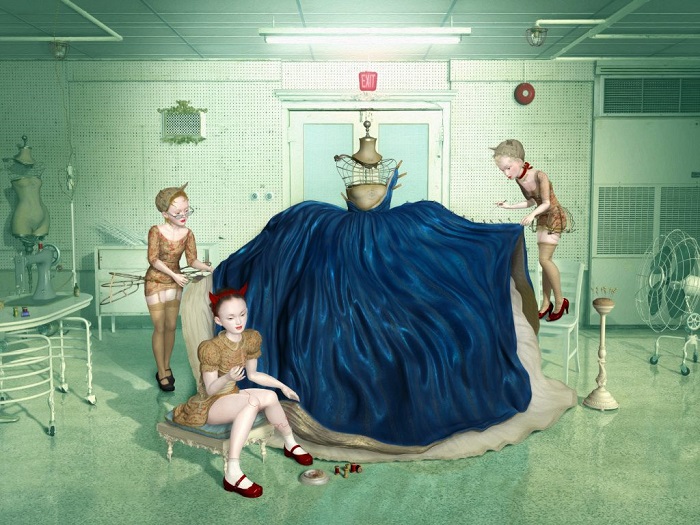
Easily. Maybe more. And about 80 percent of what I make people don’t even see. I obsessively build thousands of backgrounds, images, and objects, and then only 20 percent of them might actually end up in a piece. If I build an object I don’t use right away, I save it and it might show up in another piece later on. I’ve got a vast repository of objects I’ve built but haven’t used yet. I’ve built about five different kinds of sewing machines and now I’m in the process of building a typewriter. It might be in five different pieces, or never even be in one. I’ll just build a typewriter or whatever object because I have to.
What’s your process in getting ready for an exhibition? You have one at our gallery coming up.
I’m obsessive, I’m compulsive, I put myself under a huge amount of stress, I work constantly. It’s a really difficult time until I actually show the work, even during the show itself. I love the stress and hate it, too. Every time I make a show I give it a single word. I’ve given the name of this show Ascension, because I’m trying to ascend from one place to another and I can kind of see the doorway to achieve that. Whether I will or not, I don’t know.
How do people’s perceptions of your work affect your creative process?
I add them to my work. I like doing that. If someone says my work is creepy (I don’t think it’s creepy, but) I’ll make it even creepier. When people think it’s sick, I might push it further to see how sick it can be. I add everything like ingredients in a soup; a bit of taboo, fear, fun, humor, passion, and a bit of sorrow. I just keep adding things until it tastes good.
What was sick?
That was about how the moon affects us all. We’re all creatures of the moon, we all have our passions and every day’s another chase. The chase represents our natural instinct. We’re ruled by our instincts, we’re all dogs in this world. And yet we’re like that manicured poodle that’s trying to be something else. We’re sophisticated; we think we’re above all that. Yet we’re still the hunter and the hunted at the same time. We modify, we think we can change dogs and cows and other creatures but we’ve changed ourselves. Look at us! A few hundred thousand years ago we were making fire and trying to work out a wheel. Now here we are flying to the moon and using laptops.
Your work often gets labeled as surrealism. Does that piss you off?
Nothing pisses me off. As a child, the first book of art I got was by Dali so surrealism definitely was a starting point, but I’ve never seen myself as a surrealist. My perception of reality allows me to see beauty in odd things. I also don’t believe we are physically as we appear. I’ve often said that if you turn the lights off in a room, walk around with your arms held out and feel the space around you, you’ll feel all kind of energy coming out of your hand in the darkness. Nothing will be where you thought it was and even your own body won’t feel like you think it should. You’ll reach out for an object, which won’t be where you think it is. The world and room have changed, and so have you. My work isn’t surreal. It’s as real as I see it, or as real as I feel it.
Explain your relationship with the nonphysical world, and the types of unusual things you’ve experienced.
As a child growing up in a volatile family, I spent a lot of time alone in my room and saw people who weren’t there. They’d speak to me and they were the only ones that spoke kind words. Being more open to that that to all the volatility going on around me, I saw them as real. Maybe all children have the ability to see those things and just forget them as adults. As years went on it went away, but then returned. I would see and hear people. It was a pleasant thing, never a bad thing. They told me stories, watched as I played with my toys and dolls. They kept me company.
And this was until how old?
It was in England so I must have been between the ages of four and seven. After we came to Canada it went away. I’ve talked to a lot of people who’ve had similar experiences. I believe it’s a connection, another reality that’s around us all the time but we choose not to see. I think there’s an agreed upon collective that we don’t remember because we learn better; although, you can look past it sometimes by remembering dreams. Isn’t it strange that everyone has these epic adventures every night and then we wake up and they’re gone within seconds? You know you’ve dreamt all of these things yet you choose not the remember them. There are ways to remember, some call it sleep paralysis, which is a condition related to narcolepsy. Many people have it at various times in their life but I seem to have it a lot for some reason. Once or twice a week I’ll wake up in a lucid dream state where I’m awake in the room and can’t move. At that time I can allow my mind to hallucinate or see visions. I think they’re visions of things that have always been around us.
When did you begin having these experiences more vividly?
About seven or eight years ago a cousin’s child in my family passed away from cancer. Then a week later my mother died of cancer. She had a diagnosis of lung cancer but everything was fine, then after a period of maybe two months she went very quickly. Died in my arms in the hospital.
Soon after that your sister died as well, correct?
My sister died of bladder cancer a year after that. She had been diagnosed a month after my mom passed away.
So much loss in such a short amount of time must have been super-traumatic.
Yes. Plus, an uncle died around the same time. My wife, working in a cancer hospital and being supportive to my mother and sister and uncle during all that, really brought me face-to-face with mortality. Then a lot of those childhood visions and visitors started coming back, especially at night during sleep. I saw a doctor for it.
Did you think you were going crazy?
I did, yes. I stopped making pictures or any kind of art long before that time. But then one day my mother appeared to me. She showed me a gallery of work on the wall and said “all this is yours if you want it.” The next day I quit my job, sat in my living room for about six or seven months, and started making pictures again for the first time in 10 years, using the only tool I had at hand at the time: my computer. I ended up with all these strange images. A few years after that I found your website. Never for a minute before that email had I considered I would be an artist. Or would have ever even wanted to.
When I first saw your work, I was completely intrigued. I remember you told me a story about hiding paintings in your basement or something?
Yeah. I loved to paint on wood and Masonite panels, but I couldn’t hang them on the wall. I did a few times, and if anyone came over to the house I’d run around taking everything down. So I put them in the basement instead. I started a process of finishing the basement with them because they were nicely paneled, and then just dry walled over them. Many years later my wife complains, saying I have to have the basement done professionally, that it looks like shit down there. So we hired contractors and they started pulling down all the drywall. Eventually, one of them came upstairs and said to us, “There seems to be the art of the dead behind your walls.” He assumed it as put there years ago, before we moved in. I didn’t change his illusion.
Is it still there?
Oh no, it’s all ripped out. Working in the hospital all those years I saw awful things that burned images in my mind. The only way I was able to get them out of my head and go to sleep at night was to put them down on paper. That was actually my whole reason for making pictures. The computer is like an extension of our memory in our mind, a place I can put everything I don’t need, building up in my head. Make a picture and get it out. For example, I once saw a child who was burned with an iron, so for five years I did nothing but draw irons obsessively. Five years of irons!
That’s pretty obsessive.
Yeah. And then painting them on wood, taking them out to the backyard, and burning them. It took a long time to get specific images out of my head. dream of leaning over and telling her that her father loved her, then she fell to her knees screaming and crying. Two days later she received a phone call and fell to her knees screaming and crying. Her father dropped dead while jogging, although he was perfectly healthy. There have been experiences like that my entire life.
Do your childhood experiences play into the images you’re creating now?
Each piece I make has some connection to my past, or even my love of art. There are references to all kinds of artists in there and their work.
Would you say you’re more of a doll maker and a puppeteer than an artist?
Puppetry intrigues me; that’s why I went into animation. Puppeteers were considered worse than prostitutes back in olden times because they brought life to puppets and that was supposed to be the realm of Gods. With my artwork everyone talks about painting, but I’m actually playing with dolls; they’re my puppets. I’m creating dioramas with posed and frozen puppets.
Would you say you might have some level of clairvoyance?
I’ve had several extremely clairvoyant episodes in my life. I once dreamt about a woman I worked with whose father died– two days before it happened. I had a very vivid dream of leaning over and telling her that her father loved her, then she fell to her knees screaming and crying. Two days later she received a phone call and fell to her knees screaming and crying. Her father had dropped dead while jogging, although he was perfectly healthy. There have been experiences like that throughout my entire life.
Does that frighten you?
No. What frightens me is that I think many people have these experiences but choose not to acknowledge them. It’s kind of a calming feeling really, like something you’ve known all along. Many events tend to be around the death of people so I take certain dreams and things that happen by coincidence very seriously. I don’t ignore them. My sister, who was very close to me, died. I know one day I will die too and life is finite, but there’s a possibility it goes on to something else. Or maybe it doesn’t. We’ll never know until that day.
Follow My Blog
Get new content delivered directly to your inbox.


 rrRabbit